Storm Shelter Options: Safe Rooms & Below-Ground
Storms can be fast.
When you need safety, you need it now.
A storm shelter gives you a safer place to wait out severe weather.
Stacy Building Co. lists storm shelters as a service built for safety and long‑term protection. Construction Strength Durability, Where To Put a Storm Shelter
In this guide, we will compare two popular choices:
- Safe rooms (usually inside or attached to the home)
- Below-ground shelters (installed under ground level)
This is not a “one perfect answer” topic.
The best choice depends on your home, your yard, and your family needs.
First, know the standards (this matters most)
When people shop for shelters, they often ask, “Is it rated?”
A better question is: “What standard does it meet?”
FEMA publishes safe room guidance and points to key documents:
- FEMA P‑320 (homeowner guidance and plans) [fema.gov], [co.montague.tx.us]
- FEMA P‑361 (community and residential safe room guidance)
FEMA safe room guidance also references ICC 500, a standard for storm shelter design and construction. [fema.gov], [fema.gov] [fema.gov], [codes.iccsafe.org], [fema.gov]
Important: FEMA also states they do not endorse or certify contractors and people should not claim “FEMA approved” or “FEMA certified.” [fema.gov]
So what should you look for?
- A shelter designed and built to recognized guidance and standards (FEMA + ICC 500). [fema.gov], [codes.iccsafe.org]
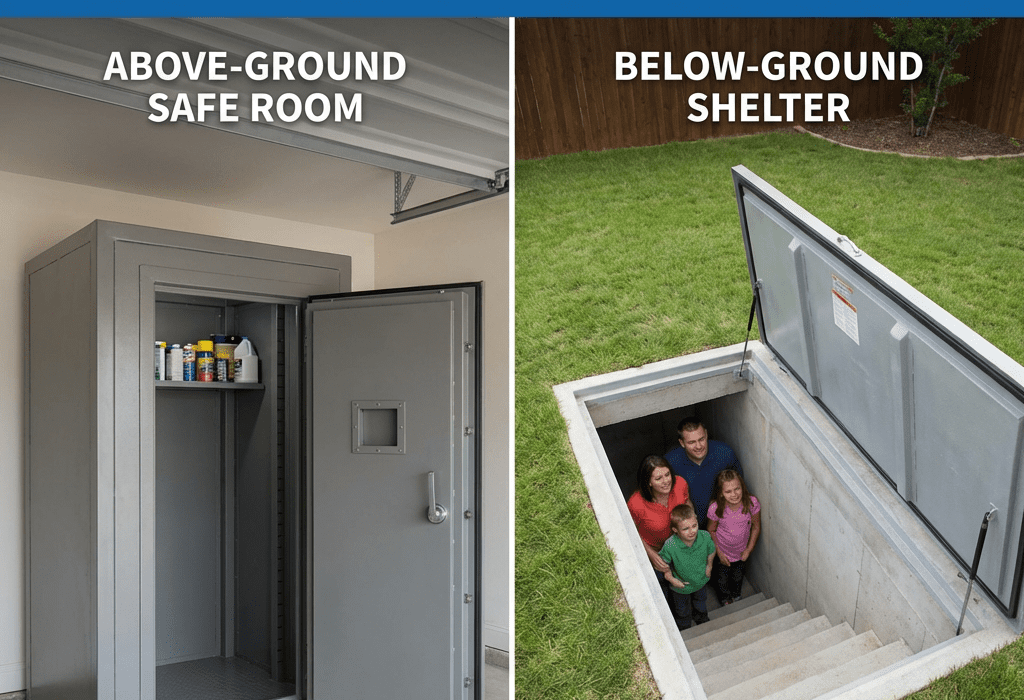
Option 1: Safe Rooms (What they are)
A safe room is a reinforced space.
It may be inside a home, garage, or another structure.
FEMA explains that safe room criteria are provided in FEMA P‑361, and residential guidance is provided in FEMA P‑320. [fema.gov], [co.montague.tx.us]
Why people like safe rooms
- Fast access (often inside the home)
- Can be easier to enter for many families
- Can be part of an existing building layout
Key thing to verify
- Ask what guidance the safe room follows (FEMA P‑320 / P‑361) and what standard it references (ICC 500). [fema.gov], [co.montague.tx.us], [codes.iccsafe.org]
Option 2: Below-Ground Storm Shelters (What they are)
A below-ground shelter is installed under ground level.
It may be placed in a yard area or under certain home/garage layouts.
People often choose below-ground shelters because they like the idea of being under the surface during a storm.
But below-ground shelters can also come with real‑world concerns.
Some storm shelter comparison guides warn about risks like:
- Water concerns (flooding risk depends on location and drainage) [atlassaferooms.com], [jtserviceco.com]
- Door access issues if debris blocks an exit [atlassaferooms.com], [jtserviceco.com]
This is why planning and installation details matter.
It is also why standards and qualified design matter.
Safe room vs below-ground: simple comparison
Here is a simple way to think about it.
Choose a safe room when:
- You want quick access inside or next to your home
- You want a shelter that does not require full excavation
- You want easier entry for kids, older adults, or mobility needs (common homeowner concern) [safe-rooms.us], [jtserviceco.com]
Choose a below-ground shelter when:
- You prefer a below-ground location
- You have a site that can support safe drainage and safe entry
- You understand access and water planning is part of the decision [jtserviceco.com], [atlassaferooms.com]
No matter which option you choose, the most important goal is the same: Follow recognized guidance and standards. [fema.gov], [codes.iccsafe.org], [fema.gov]
What to ask before you buy (easy checklist)
Use these questions when you call any shelter provider:
What standard does it meet?
Look for references to FEMA safe room guidance and ICC 500. [fema.gov], [codes.iccsafe.org]Is it designed for residential use?
ICC 500 includes residential and community shelter concepts. [codes.iccsafe.org], [The Latest…quirements]How is it installed and reviewed?
FEMA states it does not inspect or certify products or contractors.
So you should ask what documents, drawings, and local approvals support the project. [fema.gov]What about access and exit?
Ask how entry works in a real storm.
Ask what happens if debris blocks a door (common concern in comparison guides). [atlassaferooms.com], [jtserviceco.com]What about water and drainage (for below-ground)?
If the shelter is underground, talk about drainage planning. [jtserviceco.com], [atlassaferooms.com]
Common mistakes (and how to avoid them)
Mistake 1: Buying based on price only
Fix: Ask what guidance and standards the shelter follows. [fema.gov], [codes.iccsafe.org]
Mistake 2: Trusting “FEMA approved” marketing
Fix: FEMA says it does not approve, certify, or endorse contractors or products. [fema.gov]
Mistake 3: Not planning access Fix: Choose a location you can reach fast during a warning.
Mistake 4: Ignoring site water risk (below-ground) Fix: Treat drainage and water planning as a core part of the decision. [jtserviceco.com], [atlassaferooms.com]
Why Stacy Building Co.
Stacy Building Co. states they build storm shelters for strength and safety during extreme weather.
They also list their service area and contact info on their location page. Contact Us,
Get a Free Quote
Call (877) 872‑2276 or email sales@stacybuilding.com.
a { text-decoration: none; color: #464feb; } tr th, tr td { border: 1px solid #e6e6e6; } tr th { background-color: #f5f5f5; }
a { text-decoration: none; color: #464feb; } tr th, tr td { border: 1px solid #e6e6e6; } tr th { background-color: #f5f5f5; }
a { text-decoration: none; color: #464feb; } tr th, tr td { border: 1px solid #e6e6e6; } tr th { background-color: #f5f5f5; }
a { text-decoration: none; color: #464feb; } tr th, tr td { border: 1px solid #e6e6e6; } tr th { background-color: #f5f5f5; }
a { text-decoration: none; color: #464feb; } tr th, tr td { border: 1px solid #e6e6e6; } tr th { background-color: #f5f5f5; }