Where to Put a Storm Shelter: Access & Safety
A storm shelter only helps if you can reach it fast.
That is why placement matters.
This guide keeps it simple.
We will focus on two things:
- Access (how fast you can get there)
- Safety (how safe the location is)
Stacy Building Co. builds storm shelters designed for strength, safety, and long-term protection. Construction. Strength and Durability, Safe Room vs Storm Shelter
Start with the fastest access
In a warning, seconds matter.
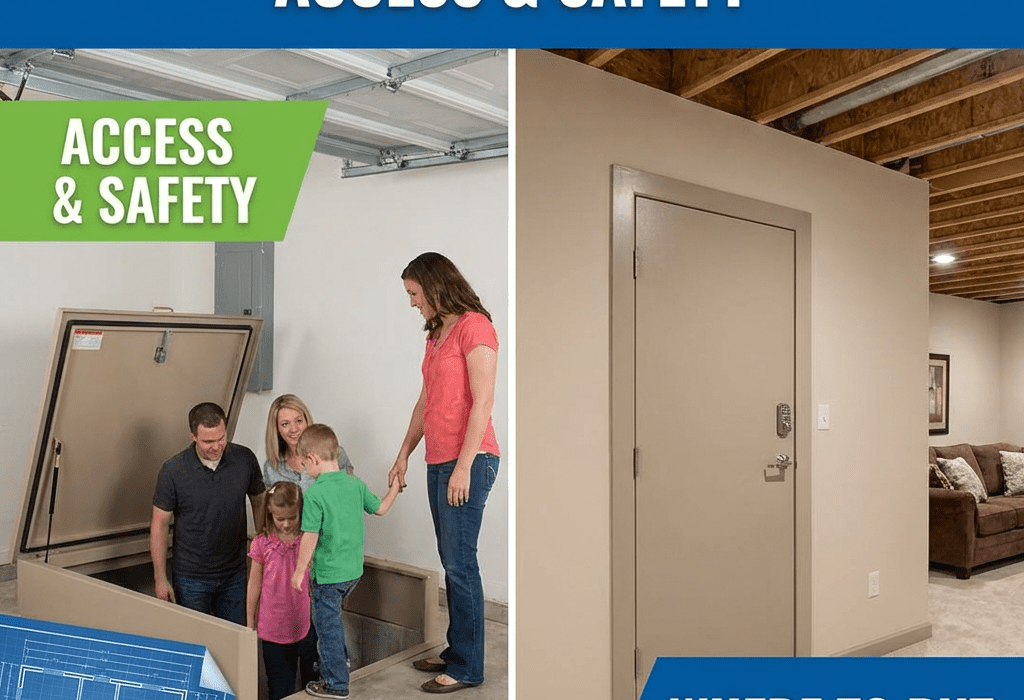
That is why many safe rooms are built:
- inside the home
- inside a garage
- or in a nearby structure
FEMA guidance and related best-practice resources commonly stress quick access.
One FEMA residential safe room fact sheet says that if a safe room is detached, it should still be within 150 feet of the nearest entrance so it can be reached quickly.
A Building America guide repeats the same idea: locate a safe room inside or within 150 feet of the home. [fema.gov] [basc.pnnl.gov]
Simple rule: closer is usually better for access. [fema.gov], [basc.pnnl.gov]
Two common placement options
Option 1: In‑residence safe room (inside your home)
This is a safe room built inside your living space.
FEMA’s “Selecting Design Criteria” advisory describes a safe room as an interior room, space within a building, or a separate building designed to protect occupants from tornadoes or hurricanes.
FEMA also describes safe rooms as intended to provide near‑absolute protection from wind forces and wind-borne debris. [fema.gov] [fema.gov], [fema.gov]
Why people like this option:
- you do not have to go outside
- it can be quicker to reach
(These are common homeowner reasons; your best choice depends on your home layout.)
Option 2: Stand‑alone safe room (near your home)
This is a separate shelter placed outside or adjacent.
FEMA’s residential safe room fact sheet says a detached safe room should be within 150 feet of the nearest entrance. [fema.gov]
Why people like this option:
- it can work when an indoor space is not available
- it can be planned near an easy path from the house
Safety check #1: Flood risk (very important)
Flooding can turn a shelter into a danger.
FEMA’s Residential Sheltering advisory states:
Safe rooms should not be constructed where flood waters have the potential to endanger occupants, and safe rooms in flood areas should not be occupied during hurricanes. [fema.gov]
FEMA also has a flood hazard siting fact sheet that says it is critical to consider flood hazards, and that FEMA does not support placing safe rooms where floodwater could endanger occupants. [fema.gov]
Simple takeaway:
Avoid low spots and flood-prone areas when choosing the location. [fema.gov], [fema.gov]
Safety check #2: A path you can use fast
Access is not only distance.
It is also the path.
You want a path that is:
- simple
- clear
- easy to use in bad weather
A Building America guide lists “protected access and egress” as a planning consideration. [basc.pnnl.gov]
Simple tip (practical): keep the route uncluttered and easy to remember.
Safety check #3: Do not trust “FEMA approved” claims
This protects you from bad marketing.
FEMA’s safe room resources page states that FEMA does not provide inspection services and does not endorse, approve, certify, or recommend contractors or products. It also says firms are prohibited from claiming “FEMA approved” or “FEMA certified.” [fema.gov]
So what should you ask instead?
- What guidance is used (FEMA P‑320 / P‑361)? [fema.gov], [co.montague.tx.us]
- What standard is referenced (ICC 500)? [fema.gov], [stacybuildings.com]
Quick placement checklist (copy/paste)
Use this when picking a location:
Access
- Can everyone reach it fast?
- Is it inside the home, or within 150 feet if detached? [fema.gov], [basc.pnnl.gov]
- Is the path simple and clear? [basc.pnnl.gov]
Safety
- Is it away from flood danger areas? [fema.gov], [fema.gov]
- Are you avoiding spots where floodwater could endanger occupants? [fema.gov]
Smart questions
- Does the builder avoid “FEMA approved” claims? [fema.gov]
- Can they explain what guidance/standards are used (FEMA + ICC 500)? [fema.gov], [stacybuildings.com], [co.montague.tx.us]
Why Stacy Building Co.
Stacy Building Co. lists storm shelters as a service and says they are designed for strength, safety, and long-term protection using reinforced materials and solid construction.
Their location page lists service area and contact info. Contact Us,
Get a Free Quote
Call (877) 872‑2276 or email sales@stacybuilding.com.
FAQ's:
a { text-decoration: none; color: #464feb; } tr th, tr td { border: 1px solid #e6e6e6; } tr th { background-color: #f5f5f5; }
a { text-decoration: none; color: #464feb; } tr th, tr td { border: 1px solid #e6e6e6; } tr th { background-color: #f5f5f5; }
a { text-decoration: none; color: #464feb; } tr th, tr td { border: 1px solid #e6e6e6; } tr th { background-color: #f5f5f5; }
a { text-decoration: none; color: #464feb; } tr th, tr td { border: 1px solid #e6e6e6; } tr th { background-color: #f5f5f5; }