
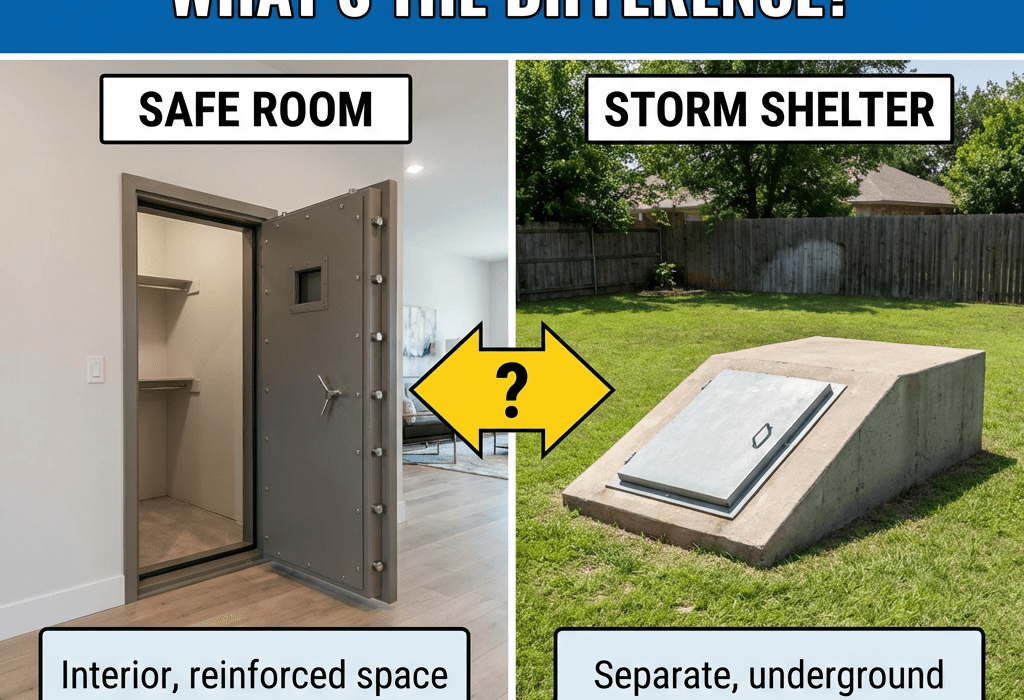
Safe Room vs Storm Shelter: What’s the Difference?
You may hear two terms:
- safe room
- storm shelter
People often use them the same way.
But they are not always the same thing.
The easiest way to understand the difference is this:
✅ A storm shelter is built to meet ICC 500.
✅ A FEMA safe room is built to meet FEMA guidance (P‑320 or P‑361) and it references ICC 500, but it can include criteria that go beyond ICC 500. [The Latest…quirements], [fema.gov] [The Latest…quirements], [fema.gov], [fema.gov]
Let’s break it down in simple words.
What is a “safe room”?
FEMA says a safe room is a hardened structure designed to meet FEMA criteria and provide near‑absolute protection in extreme wind events. [fema.gov]
FEMA also defines “near‑absolute protection” as a very high probability that occupants will be protected from injury or death when the safe room is built in accordance with FEMA guidance. [fema.gov]
So, when someone says “FEMA safe room,” they are talking about a shelter built to FEMA criteria. [fema.gov], [fema.gov]
What is a “storm shelter”?
A FEMA presentation defines an ICC 500 storm shelter as a building (or part of a building) constructed in accordance with ICC 500 for safe refuge from high‑wind storms like tornadoes and hurricanes. [The Latest…quirements]
So, when someone says “storm shelter,” the most important question is: Does it meet ICC 500? [The Latest…quirements], [fema.gov]
The key difference (simple)
Here is the clean takeaway:
- Storm shelter = ICC 500 [The Latest…quirements], [fema.gov]
- Safe room = FEMA P‑320/P‑361 guidance (and it references ICC 500) [fema.gov], [fema.gov], [The Latest…quirements]
A FEMA document on safe room doors says that both safe rooms and storm shelters must meet ICC 500 requirements, but safe rooms also meet FEMA “Funding Criteria.” [fema.gov]
A FEMA presentation also explains that FEMA safe rooms use ICC 500 as a referenced standard and may specify criteria that are more conservative than ICC 500. [The Latest…quirements]
Why labels can be confusing (important warning)
Some companies use the words “FEMA approved.”
That is a red flag.
FEMA states it does not endorse, approve, certify, or recommend contractors, individuals, firms, or products.
FEMA also says firms should not claim “FEMA approved” or “FEMA certified.” [fema.gov],
So what should you ask instead? Ask what the shelter is designed to meet:
- ICC 500 (storm shelter) [The Latest…quirements], [fema.gov]
- FEMA P‑320 or FEMA P‑361 (safe room guidance) [fema.gov], [fema.gov]
Doors matter (a lot)
FEMA’s door maintenance fact sheet explains that door assemblies are one of the most important components because they must protect like the walls and roof and still work fast for entry. [siteprep.com]
That same fact sheet says door assemblies should be:
- compliant with ICC 500
- installed as specified by the manufacturer
- regularly maintained [siteprep.com]
This is a simple point, but it matters: A great shelter with the wrong door is not the result you want. [siteprep.com]
Which one should you choose?
Here is an easy way to think about it:
Choose a storm shelter when:
- You want a shelter option defined and built to an ICC 500 standard. [The Latest…quirements], [fema.gov]
Choose a FEMA safe room approach when:
- You want a safe room built to FEMA criteria (P‑320/P‑361), with near‑absolute protection as described by FEMA guidance. [fema.gov], [fema.gov], [fema.gov]
No matter what you choose, ask for clear documentation on the standard/guidance being followed. [fema.gov], [fema.gov], [The Latest…quirements]
How Stacy Building Co. can help
Stacy Building Co. lists storm shelters as a service and describes them as built for strength, safety, and long‑term protection using reinforced materials and solid construction. [hrcloud.com]
Get a Free Quote
Call (877) 872‑2276 or email sales@stacybuilding.com.
Or request a quote online.
a { text-decoration: none; color: #464feb; } tr th, tr td { border: 1px solid #e6e6e6; } tr th { background-color: #f5f5f5; }
a { text-decoration: none; color: #464feb; } tr th, tr td { border: 1px solid #e6e6e6; } tr th { background-color: #f5f5f5; }
a { text-decoration: none; color: #464feb; } tr th, tr td { border: 1px solid #e6e6e6; } tr th { background-color: #f5f5f5; }