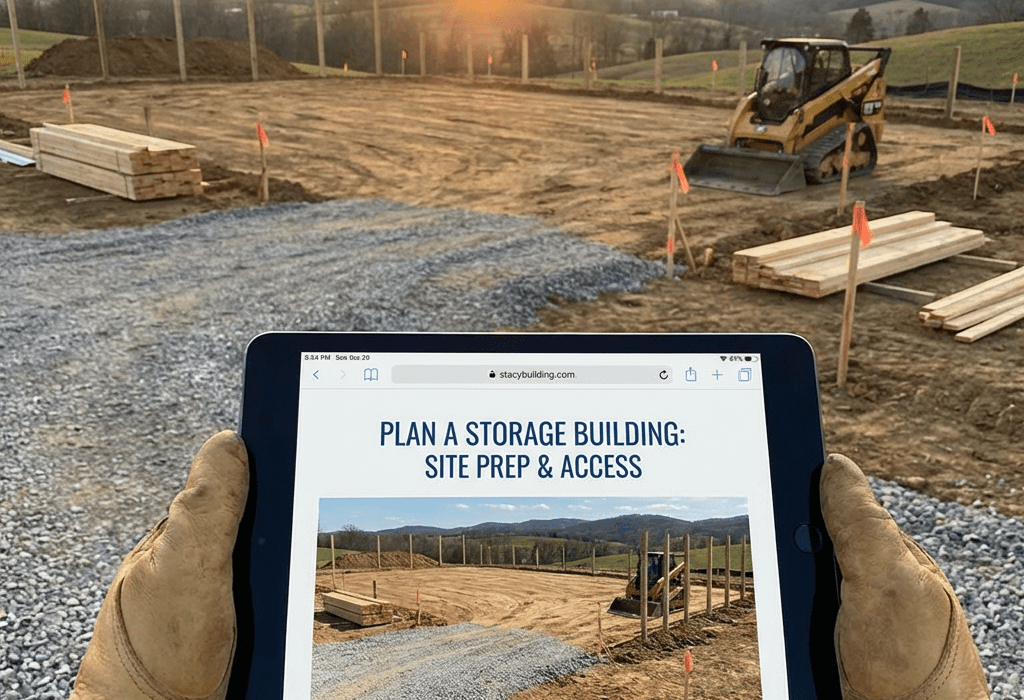
Plan a Storage Building: Site Prep & Access
If you want a storage building that lasts, start with the ground.
A strong building still needs a smart setup.
Good site prep helps you:
- Avoid soft spots and sinking
- Keep water away from your building
- Prevent doors from sticking later
- Make delivery and building day easier
Stacy Building Co. builds post‑frame buildings designed for long life and real use.
But the site matters just as much. Storage Building Site Prep & Access
Why site prep matters (more than you think)
When a site is not level, the building can shift over time.
That can lead to small problems that feel big.
Like a door that will not close right.
Or water that sits near the floor.
The goal is simple:
A level base + good drainage + clear access.
Step 1: Pick a smart spot
Start by walking your property.
Look for a spot that is:
- High and dry (not a low area)
- Easy to reach from your drive
- Away from places where water pools
- Big enough to work around
Tip: Think about how you will use the building.
If you will park equipment inside, you want room to turn.
Step 2: Check rules, setbacks, and permits
Many areas have rules about where you can place a building.
Some places also set a size limit before a permit is needed.
A common example is 200 sq. ft. as a permit trigger in many towns, but it varies a lot by location. [shedsunlimited.net]
Your safest move:
- Call your city/county office
- Ask about setbacks and permits
- If you have an HOA, ask them too
This step can save you time and money.
Step 3: Plan the delivery path (access)
Access is not just “Can it fit?”
Access means the crew can get in, turn, and set the building where it belongs.
Clear the path from the road to the site:
- Move vehicles, trailers, and equipment
- Trim low branches
- Remove yard decor and tools
- Open gates fully
Also check for:
- Soft ground after rain
- Steep slopes
- Tight corners
- Overhead lines or limbs
If the path is narrow, plan a wider route.
The easier the access, the smoother the install day feels.
Step 4: Choose your base (gravel, blocks, or concrete)
A good base helps your building sit square and stay dry.
Here are common base options.
Option A: Gravel (stone) base
A gravel pad is popular because it supports weight and drains well.
Many site guides recommend 4–6 inches of crushed gravel and making the pad about 2 feet wider than the building in each direction. [qsbuildings.com]
Why people like it:
- Great drainage
- Solid support
- Often faster than concrete
Option B: Blocks / piers (simple support points)
Blocks can work for smaller builds or certain sites.
But the ground still needs to be firm and well drained.
Option C: Concrete pad (slab)
Concrete is strong and long lasting.
Some guides note the pad should be level and can be built above surrounding grade to keep water away.
Also, crews may need working room around the pad during construction. [qsbuildings.com]
Good choice if:
- You plan heavy equipment inside
- You want a clean floor surface
- You want a permanent base
Step 5: Fix drainage before it becomes a problem
Drainage is a big deal.
Water should move away from the building.
A simple rule used in portable building guidance is a gentle grade so water runs off, such as about 2–3 inches of fall over 10 feet (example guidance; your site may differ). [bestwaypor…ldings.com]
Easy drainage wins:
- Less moisture near the floor
- Fewer long‑term repairs
- Better use year‑round
If your site stays wet, consider:
- Raising the pad
- Adding gravel
- Shaping the soil so water flows away
- Adding a small swale (shallow channel)
If you are unsure, get help before you build.
Step 6: Mark the corners and final layout
Once you like the spot, mark it.
Simple ways:
- Stakes and string
- Spray paint corners
- Flags for edges
Then check:
- Door direction (will it open to your driveway?)
- Space for ramps or steps
- Room to work around the building
This step prevents “oops” moments on build day.
Step 7: Plan for power, water, and future use
Even if you only need storage now, plan ahead.
Ask yourself:
- Will I want lights later?
- Will I add outlets?
- Will I run water?
- Will I park a vehicle inside?
If yes, plan your routes early.
Also call before you dig if you will trench.
Quick site prep checklist (copy/paste)
Use this list the week before install:
Location
- Spot is high and dry
- Enough room around the building
- Door faces the best direction
Rules
- Setbacks checked
- Permit/HOA rules checked [shedsunlimited.net]
Access
- Path is clear and wide
- Low branches trimmed
- Soft ground fixed (if needed)
Base
- Site is level
- Drainage slopes away [bestwaypor…ldings.com]
- Gravel base planned (4–6 inches is common guidance) [qsbuildings.com]
- Pad size planned (often wider than the building) [qsbuildings.com]
Common mistakes (and easy fixes)
Mistake 1: Putting it in the lowest part of the yard
Fix: Move it higher or raise the base.
Mistake 2: Forgetting the delivery path
Fix: Walk the path with a “wide turn” in mind.
Mistake 3: Skipping drainage
Fix: Shape the ground so water runs away.
Mistake 4: Building too close to a fence or tree line
Fix: Leave work space around the building.
Why choose Stacy Building Co.
Stacy Building Co. focuses on reliable post‑frame construction, clear communication, and structures built to last.
They are based in Muskogee, Oklahoma, and publicly state they serve Oklahoma and surrounding/bordering states.
They also promote free consultation / quotes. Request a Quote
Call to Action
If you want a smoother build day, start with a smart plan.
Call (877) 872‑2276 or email sales@stacybuilding.com for a quote. Contact Us
a { text-decoration: none; color: #464feb; } tr th, tr td { border: 1px solid #e6e6e6; } tr th { background-color: #f5f5f5; }
a { text-decoration: none; color: #464feb; } tr th, tr td { border: 1px solid #e6e6e6; } tr th { background-color: #f5f5f5; }
a { text-decoration: none; color: #464feb; } tr th, tr td { border: 1px solid #e6e6e6; } tr th { background-color: #f5f5f5; }
a { text-decoration: none; color: #464feb; } tr th, tr td { border: 1px solid #e6e6e6; } tr th { background-color: #f5f5f5; }
a { text-decoration: none; color: #464feb; } tr th, tr td { border: 1px solid #e6e6e6; } tr th { background-color: #f5f5f5; }
Clear the path from the road to the site. Remove obstacles, trim branches, and plan wide turns so the crew can place the building safely.