Secure a Storage Building: Doors, Lighting & Safety
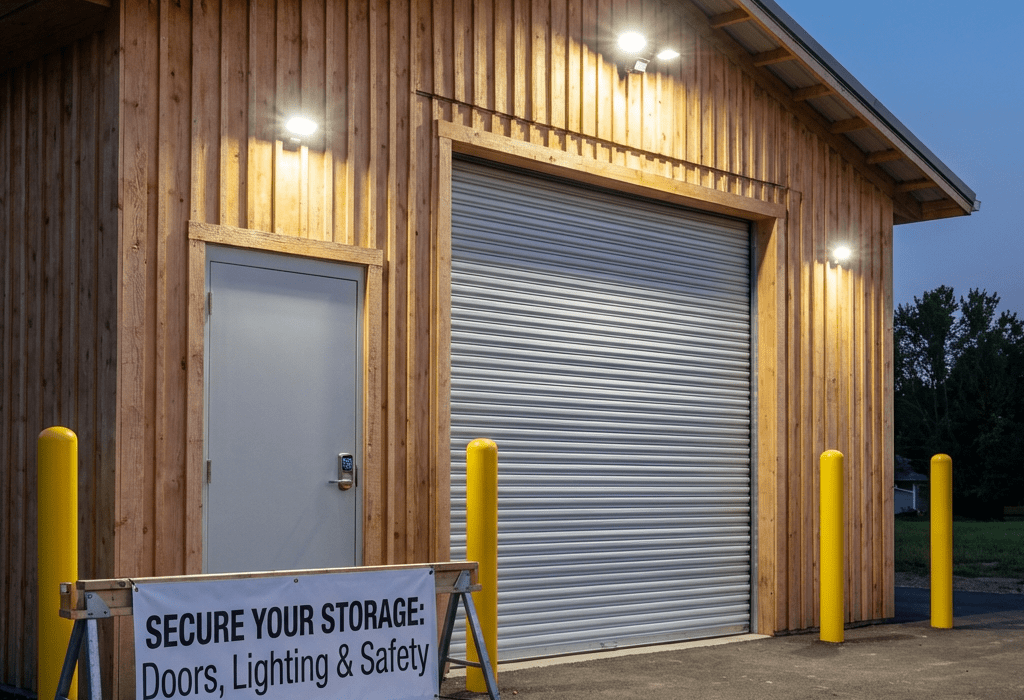
A storage building protects more than “stuff.” It protects time, tools, equipment, and often expensive investments that are hard to replace. Real security comes from a plan that covers three areas that work together: strong doors, reliable lighting, and practical safety features that reduce accidents and risk.
If you only upgrade one area, you may still leave weak points. For example, a strong lock helps, but poor exterior lighting can still create hiding places and increase risk. Lighting is widely recognized as a key part of crime prevention because it improves visibility and supports natural surveillance. [tekton-con…ltants.com], [ncpc.org]
Below is a clear, step‑by‑step guide to building real protection into a storage building.
1) Doors: Your First Line of Defense
Doors are the most common entry point, which is why door strength, latch quality, and lock choice matter so much. Storage security resources note that many facilities rely on strong locks and controlled access (like gated entry and surveillance), but the lock on the unit still plays a major role in how secure it is. [selfstorage.com], [janusintl.com]
Choose the right latch and hardware (especially for roll‑up doors)
If your storage building uses a roll‑up or corrugated door style, hardware compatibility matters. One roll‑up door parts supplier explains that most roll‑up door latches work with disc locks and padlocks, while cylinder locks require special compatibility, and mounting patterns vary (2‑bolt, 4‑bolt, etc.).
This is important because a great lock can still be limited by a weak or mismatched latch. [allfrom1supply.com]
SEO phrase to include naturally: roll‑up door latch for storage building security [allfrom1supply.com]
Use a lock design that resists cutting and prying
A common security upgrade for storage doors is choosing a lock with reduced shackle exposure. A Home Depot product listing for a shrouded padlock describes a fully shrouded design that minimizes shackle exposure and protects against bolt cutter attacks, along with construction details like a boron‑carbide “Tough‑Cut” shackle and features aimed at resisting prying and picking. [homedepot.com]
Move.org also explains what “shrouded shackle” means: it’s when the lock body covers part of the U‑shaped shackle, which reduces exposure. [move.org]
SEO phrase to include naturally: shrouded padlock for storage building door [homedepot.com], [move.org]
Add a hasp where it makes sense
If you’re securing a swing door, double door, or small access door, a hasp can help align and secure the door. Lowe’s notes that hasps are used to secure possessions in places like sheds and gates, and some feature concealed mounting screws when closed and locked to help prevent removal. [lowes.com]
Practical tip (general advice): If you install a hasp, make sure the fasteners can’t be easily accessed when the door is closed.
2) Lighting: Reduce Blind Spots and Increase Confidence
Lighting is not just convenience—it’s security and safety. Storage facility lighting guidance notes that poor lighting can increase accidents and attract criminal activity, while better lighting improves safety, visibility, and operational results.
CPTED (Crime Prevention Through Environmental Design) resources also emphasize that lighting supports safety by improving visibility and discouraging crime opportunities. [movingstor…dation.com] [ncpc.org], [tekton-con…ltants.com]
Use lighting where people walk, work, and unlock doors
A storage lighting guide recommends identifying dark spots and blind areas and emphasizes that lighting supports security by making suspicious activity easier to see.
This matters most at: [movingstor…dation.com]
- Entry doors and overhead doors
- Corners and back sides of buildings
- Parking and walk paths
- Loading and unloading zones
Aim for clear light levels (use standards)
OSHA’s construction illumination standard (29 CFR 1926.56) lists minimum illumination levels in foot‑candles for different spaces, including:
- 5 foot‑candles for indoor warehouses, corridors, hallways, and exitways
- 10 foot‑candles for plants and shops / active storerooms
- 30 foot‑candles for offices and first aid stations [osha.gov], [ecfr.gov]
For storage facilities specifically, one lighting article cites Illuminating Engineering Society (IES) guidance that recommends 10–20 foot‑candles in corridors and 5–10 foot‑candles inside units for visibility without glare. [agcled.com]
Use smart controls to avoid “lights off” risk
Storage lighting resources highlight the role of controls like sensors and timers as part of an optimized lighting plan and mention motion sensors as a common improvement path.
Practical tip (general advice): Motion lights near doors reduce the chance someone approaches a dark entry. [movingstor…dation.com], [janusintl.com]
3) Safety: Prevent Injuries, Fire Risk, and Costly Problems
Security isn’t only about theft—safety problems can cost just as much through damage, downtime, or liability. Good lighting is repeatedly tied to safer work because it reduces mistakes and helps people identify hazards. [worldofwoodcraft.com], [thomasedis…ectric.com]
Keep pathways safe and visible
OSHA’s illumination rule explicitly includes storage areas and shops as areas that must meet minimum lighting levels while work is in progress.
Practical tip (general advice): If you store items along walls, keep a clear center path so people can move safely even when carrying loads. [osha.gov], [ecfr.gov]
Reduce shadow zones in work areas
Workshop lighting guidance notes that poor lighting can lead to accidents and fatigue, while better lighting improves visibility and reduces mistakes.
Another workshop lighting resource focuses on preventing shadows by using multiple fixtures and thoughtful placement.
Even in a storage building, shadow control matters at: [toolstash.com], [worldofwoodcraft.com] [hi-hyperlite.com], [woodworkslibrary.com]
- Workbenches
- Tool walls
- Electrical panels
- Ladder and shelving areas
Think about “security + safety” systems together
Self‑storage security content highlights common facility security layers such as gated entry, surveillance, and well‑lit grounds—showing that security is usually a system, not one feature.
A self‑storage security article also describes modern risks, including burglars renting a unit and cutting through walls to reach neighboring units—an example of why layered security planning matters. [selfstorage.com], [movingstor…dation.com] [janusintl.com]
Practical tip (general advice): Pair good locks with lighting and visibility so your building is harder to target.